Still Stuck in Java 8? Time to Move to Java 17

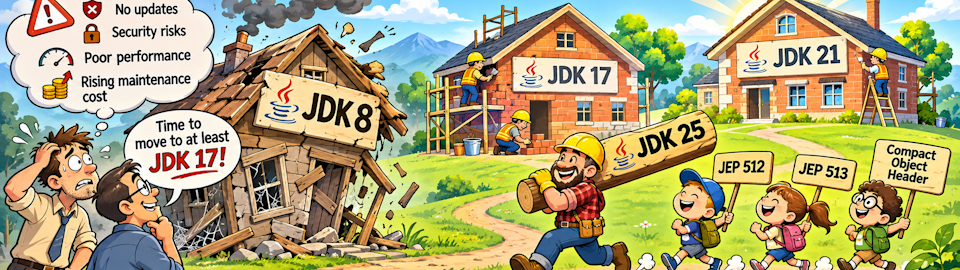
Still running Java 8 in 2026? Your dependency upgrade path deserves a closer look.
Welcome to 2026. Have You Met It Yet?
We live in a glorious, slightly terrifying era. AI can write your unit tests, generate your boilerplate, review your pull requests, and if you squint, you can apparently write your entire operating system in Rust if you give it a vague enough prompt and a weekend. The pace of change is dizzying.
Cloud-native microservices.
Serverless.
Edge compute.
LLMs baked into everything from your CI pipeline to your coffee machine's firmware.
And yet.
Right there, nestled quietly in the enterprise GitHub repository, like a well-preserved artifact in a museum nobody visits, lives a Spring Boot 1.x application, cheerfully running on Java 8.
Something like:
<java.version>1.8</java.version>
You can almost hear it humming to itself.
The LinkedIn "So-called" Expert
Ah, LinkedIn. That wonderful platform where every other week, some self-declared "Senior Enterprise Architect & Thought Leader" posts something to the effect of:
"Java 8 is battle-tested. Mature. Proven in production. The lambdas? Beautiful. The streams? Elegant. Why fix what isn't broken? #Java #EnterpriseReady #StabilityFirst"
Five hundred reactions. Mostly 🔥.
Eighteen comments that say "Great point!", or "Great insight!" boilerplate.
And one brave soul who typed "What about CVEs?" and then quietly deleted it after the replies started.
Look, we've all seen this post. Some of us have written this post. The argument is seductive precisely because it contains a kernel of truth.
They're Not Entirely Wrong. Partially. Kind Of.
Here's the thing: the Java 8 defenders aren't making things up. Oracle has, in fact, committed to extended support for Java SE 8 at least until December 2030: commercial extended support, with the uplift fee waived for Oracle SE subscribers. That's a real commitment from a very large company that has every incentive to keep enterprise customers comfortable.
And Java systems do tend to be remarkably long-lived. There's something almost admirable about a service written in 2015 that still processes invoices flawlessly at 3 AM every Tuesday. Java has a reputation for boring, reliable stability, and that reputation is earned.
This is basically the COBOL story. COBOL systems still run a staggering percentage of the world's financial transactions. Nobody argues they're exciting, but they work, they're understood, and changing them is terrifying.
COBOL is still actively maintained: IBM continues to release compiler enhancements. But its developer pool has shrunk considerably as experienced developers retire, making specialist knowledge harder to replace. Ongoing language maintenance does not automatically solve a system's staffing problem.
Java has an active, motivated, slightly-caffeinated developer community.
For example, José Paumard, Java Developer Advocate at Oracle, holder of a PhD in applied mathematics, and publisher of the excellent JEP Café video series on the official Java YouTube channel, is out here dropping shorts and deep-dives about modern Java features with the enthusiasm of someone who genuinely finds pattern matching exciting. And honestly? He's right too.
You can see his JEP Café Playlist here.
Java is not fading into legacy. Java is evolving. Which makes staying frozen at 2014 a choice, not a necessity.
2014 Called: It Wants Its JDK Back.
Java 8 was released in March 2014. That's twelve years ago. In 2014:
-
Smartwatches were "the next big thing"
-
Docker had just shipped version 1.0
-
Bitcoin was worth roughly $400
-
Nobody had a strong opinion about Kubernetes because Kubernetes barely existed
The world has changed. Java has changed. And if you're still on Java 8, you've been standing still while everything else moved.
Here's a quick look at what Oracle considers current, per their official support roadmap:
| Version | Type | GA Date | Extended Support Until |
|---|---|---|---|
| Java 8 | LTS | March 2014 | December 2030 |
| Java 11 | LTS | September 2018 | January 2032 |
| Java 17 | LTS | September 2021 | September 2029 |
| Java 21 | LTS | September 2023 | September 2031 |
| Java 25 | LTS | September 2025 | September 2033 |
Source: Oracle Java SE Support Roadmap (oracle.com), updated October 2026
LTS releases come every two years now. Java 29 is planned for September 2027. The cadence is brisk, the ecosystem is active, and Java 8 is sitting at the far left of that table looking increasingly gray.
Let Me Say This Plainly
Staying on Java 8 is a red flag.
A large one.
The kind you can see from space.
I'll say it without hedging or softening, because I think you can handle it and because someone has to.
For your personal career, the concern is whether you are learning beyond the platform you maintain. Five years of Java 8 development can include valuable engineering experience. Plenty of engineers inherit a runtime they do not control. But if Java 8 is all you know, make time to learn what modern Java offers.
Is it a red flag for the health of your system? Also yes. And this one matters a lot more.
Disagree with me if you like, but it will not change the CVE feed. It won't unship the security bulletins. Spend your energy on the migration, not on the debate.
The Exceptions (Because There Always Are Some)
Deferring a migration can be reasonable, but it needs more justification than "it's internal" or "we haven't touched it in two years."
-
Assess the exposure: isolation can reduce risk, but consider inputs, administrative access, and paths from other compromised systems.
-
Keep a patching plan: identify who provides JDK and dependency fixes, and whether your support agreements cover the versions you run. No dependency updates also means no dependency patches.
-
Document the decision: assign an owner, record compensating controls, and set a date to review, migrate, or retire the service.
NSA and CISA identify both poor patch management and insufficient network segmentation as security weaknesses. Isolation helps; it does not make vulnerable software safe. An unpatched dependency doesn't care how often you deploy.
The Real Reason to Leave: The Libraries Will Leave You First
Here's where the "Java 8 is stable" argument completely falls apart.
The JDK itself? Sure. Stable. Oracle will keep patching it through 2030.
The libraries, frameworks, and dependencies you're actually using? Those are a different story entirely.
Spring Boot 3.0: released November 2022, requires Java 17 as the minimum. Full stop. No workaround, no compatibility shim. It upgraded its Jakarta EE specifications to the versions included in Jakarta EE 10, moving the affected EE APIs from javax.* to jakarta.*. Some Java SE packages such as javax.sql retain their names, but still, the scale can be enormous.
Spring Boot 3's integrated GraalVM native image support and AOT processing, along with Spring Security 6, require Java 17 or later. For those versions, that is the baseline.
And Spring is not alone. Framework after framework, library after library has quietly dropped Java 8 support, as maintaining backwards compatibility with a twelve-year-old JDK while also innovating is a burden nobody wants to carry indefinitely.
Staying on Java 8 increasingly restricts access to maintained dependency versions.
The Costly Java 8 Ports
Some projects still maintain Java 8-compatible releases, and commercial support can provide backports: Spring, for example, has extended commercial support for Spring Boot 2.7. But coverage depends on the project, version, and support agreement. A security fix may require a newer Java baseline if no backport is available, and in most cases, that is much cheaper.
This is the trap: your supported upgrade paths narrow as dependencies raise their Java baseline. You need to know which parts of your stack still receive fixes and what happens when that coverage ends.
The Migration Is Painful. Do. It. Anyway.
Yes, migrating from Java 8 to 17 or 21 is a project. If you have a large codebase, it can be a significant one. Upgrading to Spring Boot 3 does require migrating the affected EE APIs, and that can generate a comically long diff. Your old Hibernate might need an upgrade. Your Sun APIs might need replacement.
Python folks who went through the Python 2 to Python 3 migration know this pain intimately. That migration dragged on for over a decade and was deeply, legitimately unpleasant. And yet: the Python ecosystem is thriving. Everyone who bit the bullet eventually felt better for it.
The migration is a known cost. The not migrating is an accumulating cost. Organizations are already doing this: many teams have migrated significant systems to Java 17 or 21, with full knowledge of how painful the transition was, because the alternative was worse.
But Wait, There's Also Just... Good Stuff
If the security argument hasn't moved you, let me briefly appeal to your developer soul.
Since Java 8, you've missed out on the following features. The language feature dates are documented in Oracle's language-change summary through Java 25; the Java 21 and Java 25 features below require going beyond Java 17:
Juicy stuffs if you are curious
-
Text Blocks (final in Java 15, JEP 378): finally write multi-line JSON and SQL without the concatenation nightmare
-
Records (final in Java 16, JEP 395): concise data carriers with final component fields. They are shallowly immutable: a record can still contain a mutable list
-
Sealed Classes (final in Java 17, JEP 409): controlled inheritance that actually expresses your domain model
-
Pattern Matching for
instanceof(final in Java 16, JEP 394): no more manual casting after a type check -
Switch Expressions (final in Java 14, JEP 361): return values from a switch, like a normal human
-
Virtual Threads / Project Loom (final in Java 21, JEP 444): lightweight, JVM-managed threads that make concurrent code dramatically simpler and more scalable
- JDK 24 improved this further with JEP 491: Synchronize Virtual Threads without Pinning. Blocking inside
synchronizedmethods and blocks no longer pins a virtual thread to its carrier platform thread, removing a major scalability limitation of the original implementation. This improvement is also included in JDK 25; some native-code interactions can still cause pinning.
- JDK 24 improved this further with JEP 491: Synchronize Virtual Threads without Pinning. Blocking inside
-
Pattern Matching for Switch (final in Java 21, JEP 441): pattern-based dispatch that makes your data modeling code sing
-
The Java Module System (Java 9, JEP 261); jlink (JEP 282): allowing you to build custom JREs with only what you need, shipping leaner, more secure deployments
-
Module Import Declarations (final in Java 25, JEP 511): import the public types from packages exported by a module with a declaration such as
import module java.base; -
Compact Source Files and Instance Main Methods (final in Java 25, JEP 512): write small programs with less ceremony, including
void main()without an explicit enclosing class declaration -
Flexible Constructor Bodies (final in Java 25, JEP 513): validate arguments and perform permitted initialization before calling
super(...)orthis(...), subject to restrictions on using the instance under construction -
Compact Object Headers (production feature in JDK 25, JEP 519): reduce per-object memory overhead in HotSpot. Enable them in JDK 25 with
-XX:+UseCompactObjectHeaders; JDK 27 enables them by default through JEP 534. They first appeared as an experimental feature in JDK 24. Actual heap savings depend on your application's object layout.
Looking ahead, Project Valhalla's JEP 401: Value Objects (Preview) is targeted for JDK 28 as a preview, rather than a finalized feature. It introduces identity-free value objects, giving the JVM more freedom to optimize their representation. Another reason to keep watching where Java goes next.
This is not minor. These are language-level improvements that make code shorter, safer, and more expressive. The "Java 8 syntax is sufficient" argument is technically true in the same way that "a hammer is sufficient for all carpentry" is technically true. You can still build a house. It's just a lot more work than it needs to be.
In Conclusion: Let the CVEs Speak
If the new features don't excite you, that's fine. Some people don't get excited by programming language features and that's completely valid.
But you should still plan your migration. If a dependency fix requires a newer Java version and no supported backport exists, your answer to leadership may become "we need a Java upgrade before we can apply that fix." That is a much better conversation to have before the advisory lands.
The floor is Java 17. Ideally Java 21. Java 25 LTS just dropped in September 2025 if you're feeling ambitious.
The upgrade is achievable. The community has done it. The tools exist: Spring Boot Migrator, OpenRewrite, your IDE's migration assistant. You are not the first team to do this.
So go forth, upgrade, and may your var declarations be plentiful, your records immutable, and your virtual threads gloriously lightweight.
Java 8 had a good run. It really did.
It's time.
Written by someone who has seen one too many Java 8 repositories on a Friday afternoon.